

A Tale of Two Worlds
“Stand at the crossroads and look; ask for the ancient paths, ask where the good way is, and walk in it, and you will find rest for your souls.” - Jeremiah 6:16
Our plane had only just touched the soil of the Holy Land, yet we were already eager for the thirty-day journey laid out before us. Our itinerary was perhaps a bit unorthodox (some might even call it a "strange") for our first destination lay within the West Bank of Palestine. Yet, if one looks at the old maps and the chronicles of the Bible, the path made perfect sense. We were to begin our journey at one of the roots of the story, Hebron, the covenantal land of the fathers, Abraham, Isaac, and Jacob (and the first capital of Israel). From there, the road would lead us to Bethlehem, where the King was born, and eventually to Jerusalem, the great heart of the world.
But just as these lands were contested in ancient times, they bear much turmoil today. Conflict has cast a dark shadow over the landscape, and our first steps into the country brought this divided reality into sharp, tangible focus.


We boarded an Israeli bus that made its way south through the fragmented zones of the West Bank (Areas A, B and C, which are under full Palestinian control, joint Israeli/Palestinian, and full Israeli control, respectively). We are dropped off at an almost deserted Israeli settlement in Hebron, from where we walk 15 minutes to our hostel in the H1 zone, the Palestinian-controlled heart of Hebron.
Upon crossing the checkpoint, the world suddenly changed. The streets were alive with hundreds of folk, and fruit stands and bazaars filled every corner with color and scent. It seemed every other person greeted us with a wide smile and a "Welcome to Palestine!" Cheeky boys approached us to practice their English, and kind strangers stepped out of the crowd to guide our little family through the busy streets.
“Friends Hostel" was the name of our accommodation, and a more honest name I have never found. Bilal, the young owner of the house, gave us a welcome so warm it felt like coming home. "Welcome to Hebron! Welcome to Hebron!”
What a welcome to Hebron indeed.
Earlier that day, while flying from Naples, I had written a few lines in my journal reflecting on the road ahead:
“A lot of questions await. What will our reception be, as Americans? Is the situation as black and white as the media portrays it as? And the question my family abroad is surely asking - will we be safe?!
As you will see over the coming days, our time in the West Bank painted a picture of more clarity, yet also unexpectedly, of more confusion and more pain. A few days here doesn’t tell the whole story, but it was more eye-opening than countless hours reading about it from afar. One cannot visit the ancient paths and places without feeling the weight of the world today. It is only by walking in them and alongside the people that live there that we truly learn.
THE QUIET OF ANCIENT ROOTS
"A shoot will come up from the stump of Jesse; from his roots a Branch will bear fruit." - Isaiah 11:1
As the afternoon sun began to dip into its second hour, we felt the stirrings of our first adventure. Quite near our lodgings, yet feeling as though it belonged to an entirely different age, lay the ancient Tel of Hebron (a tel is an artificial mound of accumulated debris from hundreds to thousands of years of settlements). This was the site of Israel’s first capital, holding within its earth the silent resting places of two figures from the very line of Jesus.
We walked through the bazaar, once more greeted with an array of smiles and greetings, until we reached the checkpoint to return back to the Israeli side. After crossing, we turned our faces upward, climbing a steep hill into a quiet neighborhood. Children paused their games to greet us, and their mothers offered joyful introductions. It seems that in these parts, a traveler, especially one wandering with little ones in tow, is a rare and curious sight.


Upward we went, the road growing steeper and my heart holding a small seed of doubt. There were no signposts to point the way to such a sacred and ancient place. Eventually we found a modest sign in Hebrew: The Tomb of Ruth and Jesse. At last we found it. We entered what seemed like someone’s private residence until the path wound around a building to a large open space of scattered trees, long grasses, and ancient stones, where a lone horse grazed in peace. A dirt trail led us further into this hidden realm.
There, the air grew thick with the scent of incense, and the murmurs of the Tanakh rose like the hum of bees on a Spring day. Dozens of the devout were lost in prayer and meditation; so deep was their focus that we felt like shadows as our little company passed by. We sat for a long while in the stillness, soaking in the history of the earth beneath us. To think that here, in the quiet of the hill, rested Ruth and Jesse, ancestors of our King.
It was our first true glimpse of such devotion, and the contrast with the lively, bustling streets of the Palestinian side just a few steps below was jarring indeed. Two worlds, divided by a fence, yet bound by the same ancient story.
OUR FATHERS DIVIDED
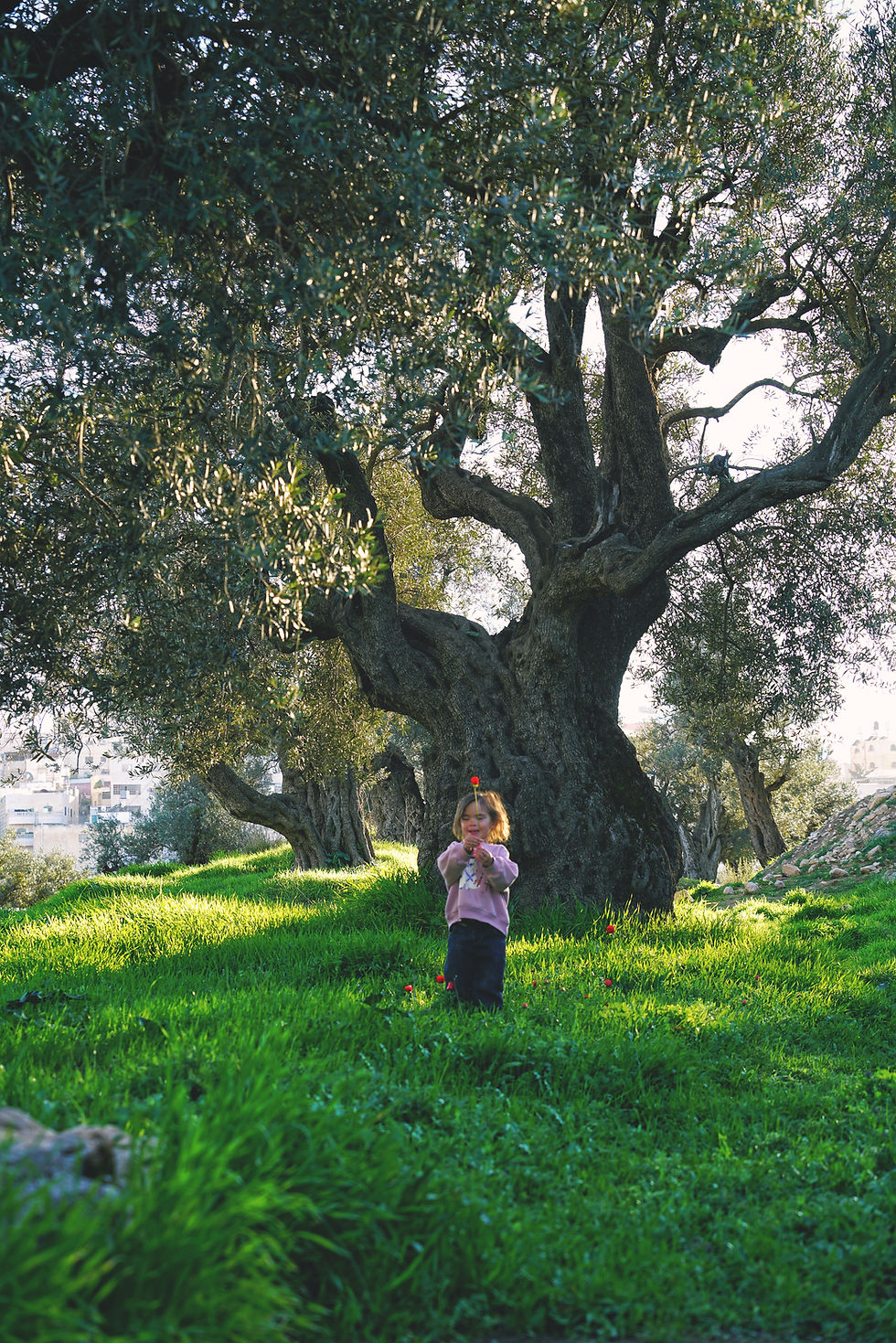
From the brow of the hill, we wound our way down the northern slopes, passing through groves of gnarled and ancient olive trees that looked as though they might remember King David himself. As we descended, the valley of Hebron opened before us as a tapestry of golden stone glowing in the afternoon light. But it was the stronghold of stone walls in the center that caught our eye and dominated the view. We set our sights upon those massive walls encircling, by the looks of it, a structure of holy significance. We tread past forgotten springs at the foot of the hill until we reached the quiet, nearly deserted streets below.
Less than 10 minutes later we found ourselves at the feet of the structure, where several Israeli soldiers motioned us to halt and requested our passports.
“Are you Christian?”
“Yes, we are,” I responded.
By the looks of us, they guessed we were neither Jew nor Muslim, and hence guessing we were Christian. To pass through these gates, one must belong to one of these three faiths.
But what manner of place was this, guarded by walls two thousand years old and built by the hands of the mighty King Herod? What treasure did it keep safe? For the Jews, it is a place held in honor second only to the Western Wall; for the Muslims, it is revered alongside Mecca and the Dome of the Rock.
This was Machpelah, the Cave of the Patriarchs. Here, deep beneath the stone, lie the resting places of the fathers of our faith: Abraham, Isaac, and Jacob, and their wives beside them. A place of beginnings, whom God made an everlasting covenant.


We climbed up the steps until we were dwarfed by the massive stones that make up the walls. It was the work of Herod, typical of his fashion to use the sheer strength of stone to impose his dominion upon the land (a trait we would come to know even more personally on the morrow). At the base of the rampart, I caught sight of cavernous openings in the limestone, the only hint of how this place might have looked in the distant days of Abraham’s wandering.
As we crossed the threshold, we were greeted by an elderly man with a bowl of small sweets, to which Zion and Joy River accepted with absolute delight. Inside, much like at the Tel, we found ourselves amidst the deep rituals of the Rabbis and those who study the Law. Most eyes were turned toward a heavy gate of green iron, through which one might catch a glimpse of the tomb of Abraham.
You see, Machpelah is a place strangely divided. One part for the folk of Judah on the Israeli side, and the other for the Muslims on the Palestinian side. By strict decree, neither may cross into the other’s domain. The tombs themselves lie within the Muslim half, meaning the Jewish may only peer at them through iron bars. Is this not a picture of the great complexity of the West Bank?
We, being travelers from a third nation and of the Christian faith, were the only ones permitted to walk in both worlds. Yet, as the sun began to set on this Thursday - the eve of the Muslims holy day - the other side of the complex might already be closed. We made the journey to find out, a long and winding trek through two separate checkpoints, only to find our concerns were made true. A man stood at the entrance and greeted us with great warmth, apologizing for the closure (though I felt he had no need to do so).
Thus we turned away into the quiet streets of Hebron, in which darkness has now engulfed. Little did we know that the road had one more adventure in store for us before this first day was through.
TEA AND IRON
“Every kingdom divided against itself is brought to desolation, and every city or house divided against itself will not stand." - Matthew 12:25
The road outside had grown eerily still and dark. The market stalls, which but a few hours ago had been bustling with life and trade, were now shuttered and silent. The echoes of children’s laughter and the occasional passerby were the only things that kept the night air alive. I will admit to a slight unease; we were, after all, in the heart of the West Bank at night. The warnings of travel advisories and the shadows of the mind played their part, yet the reality of the street seemed little to fear.
I mapped out the path to our hostel (a 20 min walk) until we were greeted by a middle-aged man sitting on the steps of a closed shop. He sprang up, and with broken English, gladly invited us to his home. Mary and I shared a glance, reading the unspoken thoughts upon each other’s faces as we have so often done on our travels, and we accepted. He first led us through the winding streets, stopping at a still-open glass-smith shop. A legend of Hebron himself, this glass-smith created beautiful pieces of every shape and color you can imagine.
Then, our guide led us into a maze of narrow alleys - up two flights of stairs, a turn to the right, and then the left - until we found ourselves in his living room. It was a comfortable room, lined with floral cushions and purple sofas. We awkwardly sat down while he left us there all alone. I glanced at his treasures - photos of his family and the trinkets he collected over the years - until he came in with a silver tray of coffee and tea. We sat there for 15 minutes, enjoying the (very bitter) Arabic coffee and red tea. We sat for a time, speaking simply as best we could, grateful for this glimpse into a life different from our own, yet also quite the same.


We respectfully asked to leave, which he then continued to guide us through the streets. We even stopped by an ancient Turkish hammam turned museum. But here, the road took on a peculiar and sobering sight: the entire street was covered in chains and netting. He explained the startling truth of this divided city. We walked upon the Palestinian road, but the windows directly above belonged to the Israeli side. So often had things been thrown down from above that a barrier had to be woven between the neighbors. No other city in the world, perhaps, bears such a stark and jagged border.
The man’s cheerful spirit turned somber as he spoke of the long years of endurance and the pain his people had carried. It is one thing to read of such strife online, but to stand beneath that net makes the sting of reality far sharper. People are people, no matter what faith or background.
Nearing our accommodation, we ran across one of our hostel mates. We decided to walk back with him and said goodbye to not only our guide through the streets, but also friend. I felt moved to offer him some shekels for his kindness; he refused strictly at first, though in the end, he accepted it with a nod.
Back at the relative comfort of our hostel, I called my parents and gave them quite a fright. I suppose many would think it reckless to bring a family into such a place, or foolish to follow a stranger into the dark alleys of Hebron. Perhaps it was. But we did not come to these ancient lands to watch from behind a wall.
We came to see, to experience, and to understand. It was but our first day, yet we had already walked a road that few ever get the chance to tread.
Thank you for reading the story.
If you enjoyed this story and want to read all the newest stories, please subscribe to Into Far Lands and join the family!
More Stories from Far Lands

Part 2 of 'East of Eden'

A Father's welcome in Haghpat, Armenia
.jpg)
Story of discovery in the Andes of Peru.