

Life At Its Lowest
Jericho, the lowest city on earth and cursed throughout time, still stands as a place where life is found.
What a day it had already been in this Holy Land, from the heights of the Herodium to the churches of Bethlehem. By second hour of the afternoon, our hearts felt full and our feet already weary, so we had every intention of finding a quiet corner in a restaurant to rest before making our way back to our hostel.
But the road has a way of leading you where you did not intend to go.
A taxi driver approached us, his eyes bright with the prospect of new customers. At first, we tried to shoo him away, for we had no desire for more travel and even less to haggle. Yet he persisted, saying something that made us stop dead in our tracks:
"Jericho for two hundred shekels, and I bring you all the way home!"
We glanced over at one another, then back at him. I had been trying to fit the ancient city of Jericho into our plans to no avail, and I had finally accepted that it would remain a tale for another trip. But this offer was far too tempting to ignore. You likely know by now what we decided to do, don't you? And so it was that by the second hour past noon, we found ourselves settled into his car, rattling away toward the sun-drenched plains and palms of Jericho.


We followed the Wadi Qelt from Jerusalem, plunging down through the rugged Judean wilderness. The road was a steep descent, dropping from 2,600 feet above sea level to 800 feet below it, the lowest city in the world. Our driver flew down those winding roads with too much confidence, while we sat in the back, placing our lives and our trust in this stranger we just met. A small voice in the back of my head wondered if he would truly stay faithful to his promise to visit the site in Jericho and return us back to Hebron, but for the moment, we were bound for Jericho. That was enough.
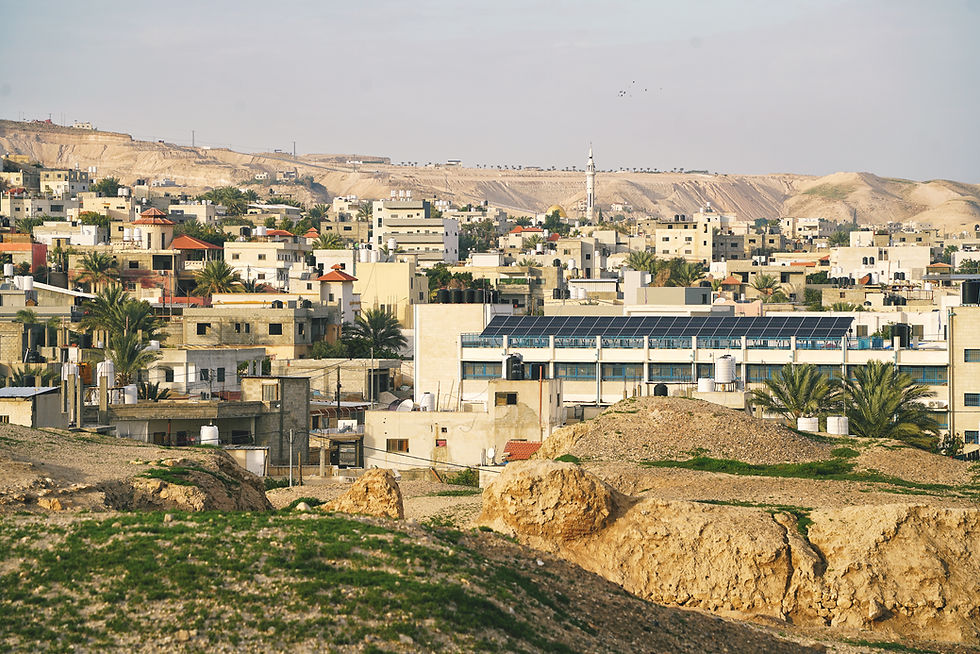
Before long the rocky terrain gave way to endless rows of date palms lining the road in both directions, a tall tale sign that Jericho is near. As the road grew more congested, we finally rolled into the heart of modern Jericho.
I must confess, it was quite unlike the city I had pictured during those Sunday school lessons of old. There were no towering stone walls trembling at the sound of a trumpet, but rather a bustling, moderately sized town alive withh shops, markets and malls. Though the city was once cursed to the ground, it seems to has risen again, even though less formidable than the stronghold of Joshua’s day.

The Tell of Jericho, known locally as Tel es-Sultan, appears at first glance to be little more than a vast, earthen mound rising out of the town. To our surprise, it was not large in the slightest sense. A traveler could easily walk the length of it in fifteen minutes and see all the points of interest, though we lingered for closer to forty. Beneath our feet lay layers upon layers of ancient settlements (twenty of them, in fact), stacked like the pages of an ancient book. The deepest, oldest sections, only a few of which are exposed to the sun, date back a staggering 11,000 years into the distant past.
The true highlight of the mound is a glimpse of the ancient stone tower and city wall. At over 8,000 years old, it is the oldest defensive wall ever discovered in the world. I stood there for a long moment, gazing upon those ancient stones stacked one upon the other, wondering what tales they would tell if they could only speak.
It is a story of a city that rose and fell, crumbled and woke again, more times than the world remembers.

“Now the gates of Jericho were tightly shut because the people were afraid of the Israelites. No one was allowed to go out or in. But the LORD said to Joshua, “I have given you Jericho, its king, and all its strong warriors. You and your fighting men should march around the town once a day for six days. Seven priests will walk ahead of the Ark, each carrying a ram’s horn. On the seventh day you are to march around the town seven times, with the priests blowing the horns. When you hear the priests give one long blast on the rams’ horns, have all the people shout as loud as they can. Then the walls of the town will collapse, and the people can charge straight into the town.” Joshua 6:1-5
This account is surely known to most who have read the Bible, and it is the first one that comes to mind hearing of Jericho. Standing there amid the dust of the site, two realizations took hold of me.
First, the ancient walls were remarkably thick and high, far more formidable up close than I had pictured in my mind. Second, the entire walled city was surprisingly small. In the Sunday school lessons of our youth, Jericho always looks like a vast, sprawling city. But standing on the actual ground, you realize that walking around it seven times in a single day was not the impossible task it sounds like when compared to our modern cities. In fact, a company of men could likely march around the entire perimeter seven times in an hour.
But the story of Jericho does not end in the fallen rubble, both in history and for our visit. Leaving the ancient mound, I asked our driver to take us 2 miles to the northeast to a little known site that holds one of the most beautiful treasures found in the Middle East. This is the ruins of Hisham’s Palace, a desert oasis built in the early days of the Umayyad dynasty in the 8th century AD. Here, they managed to transform a barren landscape into a place of beauty. We passed stone arches until we reached a large complex, covered entirely the most beautiful and delicate mosaics I have ever seen (and I’ve seen a lot).
Stairs were recently constructed to view them from above, with each room housing geometric patterns more intricate than the previous, until we saw it - the Tree of Life mosaic. It is a true masterpiece that has survived the ages. On one side of the great pomegranate tree, two gazelles graze in perfect peace; on the other, a fierce lion attacks a lone gazelle. It is a striking picture of the world we live in, a world caught between beautiful peace and violent conflict.


Standing there in the lowest (and possibly oldest) city on earth, a profound biblical connection became clear. In the scriptures, Jericho is a place associated with the curse. After its walls fell, Joshua pronounced a heavy curse upon the city (May the curse of the LORD fall on anyone who tries to rebuild the town of Jericho. At the cost of his firstborn son, he will lay its foundation. At the cost of his youngest son,he will set up its gates.” Joshua 6:26). Centuries later, its waters were bitter and caused death, until the prophet Elisha threw salt into the spring and healed the waters, bringing life back to the oasis (2 Kings 2:19-22).
The Bible begins with humanity losing access to the Tree of Life in Genesis because of sin, leaving us to wander in a cursed wilderness. Yet, God’s mission has always been about entering our lowest, most broken places to restore what was lost. It is no coincidence that Jesus traveled through Jericho to find Zacchaeus and heal the blind, bringing salvation to a city traditionally marked by darkness.
How appropriate, then, that our very last stop in this ancient city was to stand before the gnarled branches of the traditional sycamore tree of Zacchaeus. There, right in the bustling streets of modern Jericho, stands a beautiful truth: a simple tree where a broken man climbed high just to catch a glimpse of the King, only to find that the King had already come down into the low country to find him.


Thank you for reading "Life At Its Lowest"
If you enjoyed this story and would like to follow along as our family retraces legendary places and figures of the Bible, please subscribe to Kingdoms Collide


More Stories from Far Lands